
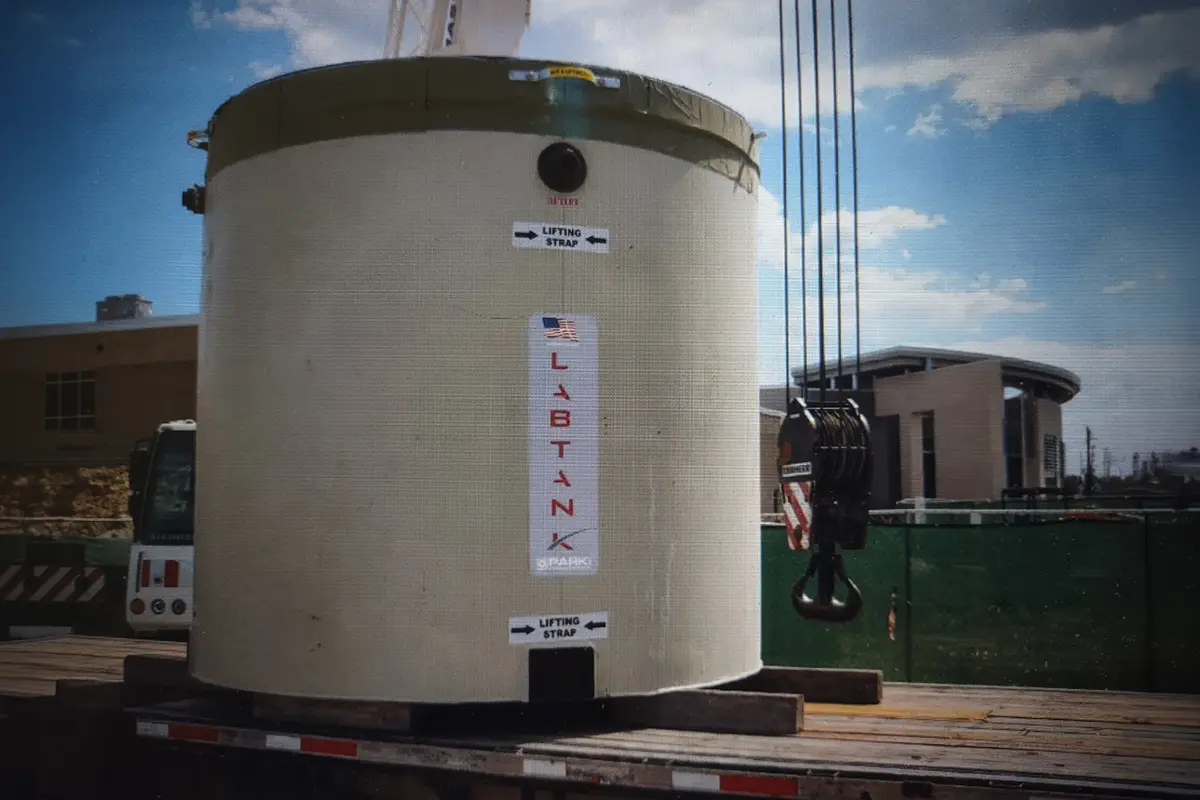

They Reveal the Future of DrainFlow Infrastructure
Pretreatment lab tanks were once considered a niche requirement—limited to specialized industrial facilities and highly regulated research environments.
Today, they are becoming a standard feature across a much broader range of buildings.
From universities and K–12 schools with science programs, to hospitals, pharmaceutical labs, biotech campuses, mining & rare earth labs, and advanced manufacturing facilities, these systems are increasingly being designed into facilities from the beginning—not added later as an afterthought.
This shift matters.
Because pretreatment lab tanks are not just equipment.
They are a physical expression of a much larger infrastructure change taking place inside modern buildings.
From Equipment to Infrastructure Layer
A 500 to 2,500-gallon lab tank installed in a school or research facility may appear, at first glance, to be a standalone system component.
In reality, it functions as part of a broader internal water lifecycle system that governs how water is managed before it ever reaches municipal infrastructure.
These systems are typically used for:
- Flow equalization
- Effluent buffering
- Contaminant management
- Discharge stabilization
- Regulatory compliance support
What makes them important is not just their function—but their position in the system.
They sit between facility water use and downstream municipal systems.
That position defines their significance.
The Missing Layer in Water Infrastructure
Most water discussions are traditionally divided into two categories:
Water In
- Supply
- Consumption
- Efficiency
- Conservation
Water Out (Municipal Systems)
- Wastewater treatment
- Stormwater infrastructure
- Regional conveyance
- Environmental discharge
But this framework leaves out a critical layer.
Inside modern facilities, there is an expanding system that manages water after use, but before discharge.
This includes:
- Pretreatment systems
- Lab and Acid tanks
- Neutralization systems
- Internal drainage infrastructure
- Stormwater detention systems
- Controlled discharge systems
This is the internal Water-Out layer.
And it is growing.
Why This Layer Is Expanding Now
Several structural trends are driving the expansion of pretreatment and internal water management systems:
- Growth of lab-intensive environments (biotech, pharma, education)
- Expansion of advanced manufacturing and materials science
- Increased regulatory focus on discharge quality and variability
- Larger facility footprints with more complex water use
- Greater sensitivity in municipal treatment and conveyance systems
As a result, water is no longer simply used and discharged.
It is actively managed across multiple internal stages before it leaves a facility.
The System Boundary Insight
Pretreatment lab tanks sit at a critical infrastructure boundary.
They represent the interface between:
- Internal facility operations
- External municipal infrastructure systems
That boundary is where multiple forces converge:
- operational process water
- discharge quality requirements
- regulatory compliance thresholds
- downstream infrastructure capacity constraints
This makes pretreatment systems fundamentally different from most facility equipment.
They are not isolated components.
They are interface infrastructure systems.
Why This Matters for DrainFlow
Understanding pretreatment systems reveals something larger:
Modern water infrastructure is not linear—it is layered, distributed, and increasingly internalized within buildings.
This creates a new category of visibility into:
- drainage behavior
- discharge variability
- compliance exposure
- infrastructure dependency
- downstream system constraints
This is the foundation of DrainFlow.
Not as a product or service.
But as a way of understanding the Water-Out system inside modern infrastructure.
A Structural Shift in Building Design
Historically, buildings were designed around core infrastructure systems such as:
- Structural systems
- Mechanical systems
- Electrical systems
- Plumbing systems
Today, a new layer is becoming increasingly important:
Internal water lifecycle systems
Including:
- Pretreatment infrastructure
- Stormwater management systems
- Discharge control systems
- Water reuse systems
Pretreatment lab tanks are one of the clearest physical manifestations of this shift.
They show that water management is no longer external to the building.
It is embedded within it.
From Water In to Water Out
Most organizations have developed mature systems for managing Water In:
- sourcing
- consumption
- efficiency
- conservation
But the growing complexity lies in Water Out:
- discharge management
- pretreatment requirements
- stormwater systems
- infrastructure capacity
- regulatory compliance
- downstream variability
As facilities become more complex, Water Out is becoming just as important as Water In.
Closing Thought
Pretreatment lab tanks are often viewed as specialized environmental equipment.
But at scale, they represent something more significant:
The emergence of a distributed Water-Out infrastructure layer inside modern buildings.
Understanding this shift is essential.
Because it explains not only how infrastructure is changing—but why DrainFlow exists as a category today.
About DrainFlow
At DrainFlow, we help organizations better understand the water infrastructure systems that often remain hidden beneath the surface. From drainage and stormwater to water movement across entire facilities, greater visibility can help support resilience, compliance, and informed decision-making.