

Becoming a Utility-Constrained Infrastructure System
Over the past decade, industrial distribution warehouses have quietly transformed in both scale and function.
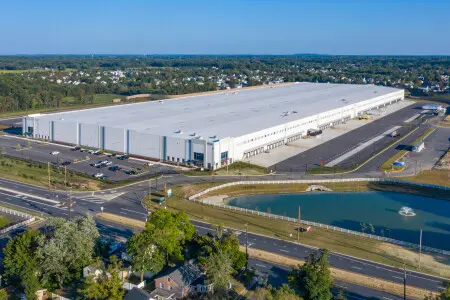
What were once relatively simple logistics buildings have become massive tilt-wall structures—designed for throughput, automation, and regional distribution at scale.
But something more important is happening beneath the surface of this expansion.
Industrial real estate is no longer defined primarily by the building.
It is increasingly defined by the utility systems that make the building possible.
The most overlooked part of modern industrial warehouses is not the building—it is the engineered water system required to make the building viable. The pond is as important as the warehouse itself.
This is a “flow-managed” industrial system. Industrial development is shifting from building-centric design to utility-constrained systems design.
The shift most people are not seeing
In many modern industrial developments, the building itself is only one part of the system.
Equally important are the underlying constraints that determine whether a site can even be developed:
- Power availability
- Water supply
- Wastewater capacity
- Stormwater detention requirements
- Drainage and runoff management
- Road and freight infrastructure
These are no longer background engineering considerations.
They are becoming gating conditions for development.
The pond is as important as the warehouse itself
From a pure land-use perspective, a significant portion of the site is dedicated to:
- delaying water release
- specified pump lift stations
- roof runoff from an extremely large impervious roof
- controlling downstream flow rates
- meeting municipal discharge constraints
That means:
A meaningful percentage of industrial land is now “hydrologic infrastructure,” not usable building or logistics space. The building footprint and the water footprint are now designed together.
The rise of impervious surface engineering
One of the most significant changes in modern warehouse design is the sheer amount of impervious surface coverage.
Large roofs. Extensive truck courts. Paved circulation areas.
From a design perspective, this creates efficiency for logistics.
From a hydrologic perspective, it creates a challenge.
Stormwater no longer infiltrates naturally at the site level. It must now be:
- captured
- stored
- slowed
- and released in controlled ways
This is why many newer industrial facilities now include:
- large detention basins
- underground storage systems
- and in many cases, pump-assisted discharge systems
Stormwater is no longer passive infrastructure.
It is actively engineered flow control.
Repurposing changes everything
A growing number of these large industrial facilities are being developed speculatively, sometimes sitting partially or fully vacant for extended periods.
Over time, many are repurposed for other high-intensity uses, including advanced manufacturing and data center infrastructure.
What makes these facilities attractive is not just their size.
It is their embedded utility access and structural flexibility.
But repurposing also exposes a critical constraint:
Existing utility systems were designed for a different operational profile.
That includes:
- stormwater runoff assumptions
- wastewater discharge rates
- cooling and energy loads
- and site drainage capacity
When usage changes, the infrastructure beneath the building often becomes the limiting factor.
The real constraint is not the building
A common assumption is that industrial development is limited by land availability or construction cost.
In practice, the constraint is increasingly the capacity of underlying utility systems to absorb new demand.
In other words:
The question is no longer just “can we build it?”
It is becoming:
“What can the site’s water, power, and wastewater systems actually support?”
A structural shift in infrastructure thinking
What we are seeing is a quiet but important shift in how industrial sites are engineered and evaluated.
Stormwater systems, drainage infrastructure, and utility capacity are no longer secondary design elements.
They are becoming central determinants of:
- site feasibility
- development timelines
- and long-term adaptability
This changes how we think about industrial real estate.
Not as static buildings.
But as evolving infrastructure platforms constrained by underlying utility systems.
Final thought
Industrial distribution is often described in terms of square footage, location, or logistics efficiency.
But the more important layer is becoming less visible:
The engineered systems that manage water, energy, and flow beneath and around the building itself.
Those systems increasingly determine what a site can become—not just what it is today.
About DrainFlow
At DrainFlow, we help organizations better understand the water infrastructure systems that often remain hidden beneath the surface. From drainage and stormwater to water movement across entire facilities, greater visibility can help support resilience, compliance, and informed decision-making.